Rust farm irrigation circuit
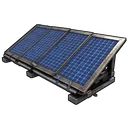
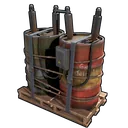
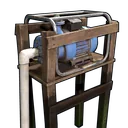
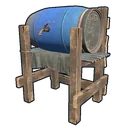
A water pump on a river fills a barrel on the roof; a fluid splitter feeds three sprinklers below. The powered pump pushes uphill, and each sprinkler uses 2 water per second while it gets any flow.
How to wire it
- Large Solar Panel "Electric Output" → Water Pump "Power In"
- Water Pump "Water Output" → Water Barrel "Water In"
- Water Barrel "Water Out" → Fluid Splitter "Water In"
- Fluid Splitter "Water Out 1" → Sprinkler "Water In"
- Fluid Splitter "Water Out 2" → Sprinkler "Water In"
- Fluid Splitter "Water Out 3" → Sprinkler "Water In"
Ready circuits
Open one in the editor, test it and change it.
- Solar turret
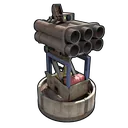
- SAM site
- Button door
- HBHF tesla trap
- Night lights
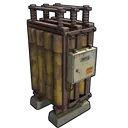
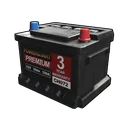
- Battery backup
- Fuel generator smart switch
- AND gate
- OR gate
- XOR gate
- Memory cell
- Counter
- Seismic sensor alarm
- Turrets with branches
- RF door
- Farm irrigation
- Water purifier with pump
- Water catcher to barrel
- Fluid switch pump
- Item sorter
- Auto furnace
- Auto crafting

How Rust electricity works
Power in Rust is pushed, not pulled: a source sends everything it makes down the wire, and each component decides what to pass on. A splitter divides what comes in evenly between the outputs that have a wire, without looking at what each one needs; whatever isn't used is lost. A branch sends a fixed amount out of Branch Out and the rest straight on.
Batteries are the exception that makes bases work: a battery always pushes its full output (15, 50 or 100), but it only spends what the things wired after it actually use. That's why a battery feeding a turret and a light through a splitter drains 11 per second, not 50. It charges at 80% of what comes in.
Most components that only route power use none: splitters, branches, switches, timers, counters and logic gates. Lights, sensors, RF and door controllers use 1, the auto turret 10, the SAM site 25. A component that gets less than it needs doesn't run and doesn't spend anything.